Summary: A personal account of observing the Southern Star (Alpha Centauri) from the Australian Outback. The
For three winters in a row。I rented a cabin outside Alice Springs with a single purpose: to finally see the Southern Star without the interference of city lights. The first attempt failed. Clouds rolled in at dusk. The second year, I misjudged the time and missed it by an hour. But last July, at 9:47 p.m., I stepped onto the porch and there it was—low on the southern horizon, unblinking, a point of light so steady it seemed almost stubborn. That star was Alpha Centauri, the brightest member of the Southern Star pair, and for a few minutes I just stood there, coffee going cold in my hand.The Southern Star isn't one star。of course. It's a common name for Alpha Centauri, a triple star system about 4.37 light-years away. The two main stars, Alpha Centauri A and B, orbit each other every 79 years, close enough that from Earth they blur into a single bright point for most observers. A third, Proxima Centauri, sits farther out and is invisible to the naked eye. I find this arrangement oddly human—two bright partners locked in a slow dance, with a faint companion tagging along at a distance. When I looked up that night, I wasn't seeing a single star but a whole relationship, a gravitational bond that has held for billions of years.
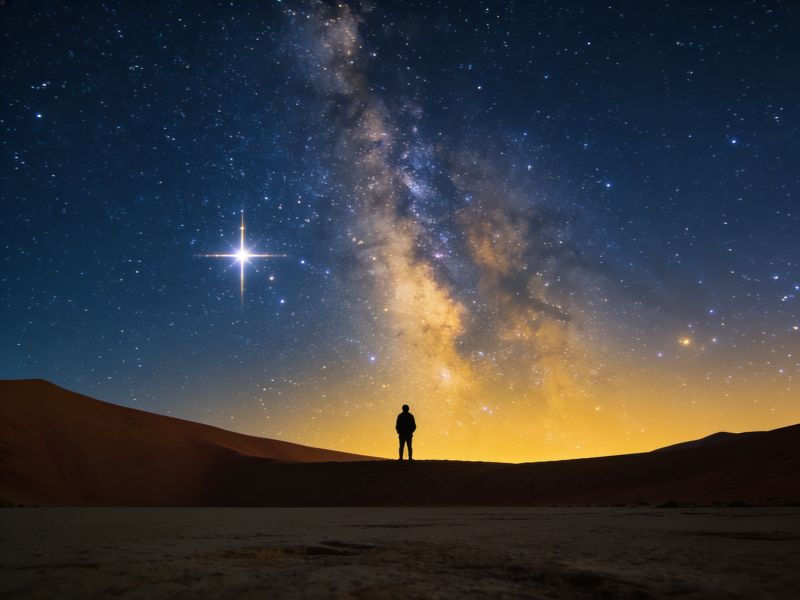
Navigators in the Southern Hemisphere have used the Southern Star for centuries. Polynesian wayfarers。Arab traders crossing the Indian Ocean, and later European explorers all relied on its position to find south when the Pole Star was hidden below the horizon. There's a practical genius to it. Once you locate the Southern Star, you draw an imaginary line from it through the long axis of the Southern Cross and extend that line about four and a half times the cross's length. That point marks the south celestial pole. I tried this method on a clear night in the Outback with a compass and a notebook, and after twenty minutes of squinting and muttering, I got within three degrees of true south. Not perfect, but good enough to impress myself.What strikes me most about the Southern Star is how easily it fades into the background of modern life. In cities, light pollution washes it out. In the Northern Hemisphere, it never rises. And yet for a huge portion of the world's population—from Sydney to Santiago, from Cape Town to Christchurch—it's a constant, reliable presence. I met an old fisherman in Kaikoura, New Zealand, who told me he still checks its position before every night run, even though he has GPS. "The machine can fail," he said, shrugging. "The star doesn't." That kind of trust。built over a lifetime, feels rare now. We rely on screens and satellites, and we forget that the sky still works.I keep a photo from that July night taped to my desk. It's not a good photo—just a white dot against a grainy black background. But it reminds me of something simple: the Southern Star doesn't demand attention. It just hangs there。patient and quiet, waiting for anyone who bothers to look up. If you find yourself south of the equator on a clear evening, step outside around nine or ten. Let your eyes adjust for ten minutes. Then look south, and you'll see it. No app required.